Your cart is empty






Küche






3D ONLINE KÜCHENPLANER





The invisible extractor hood: How good are cooktops with extraction?
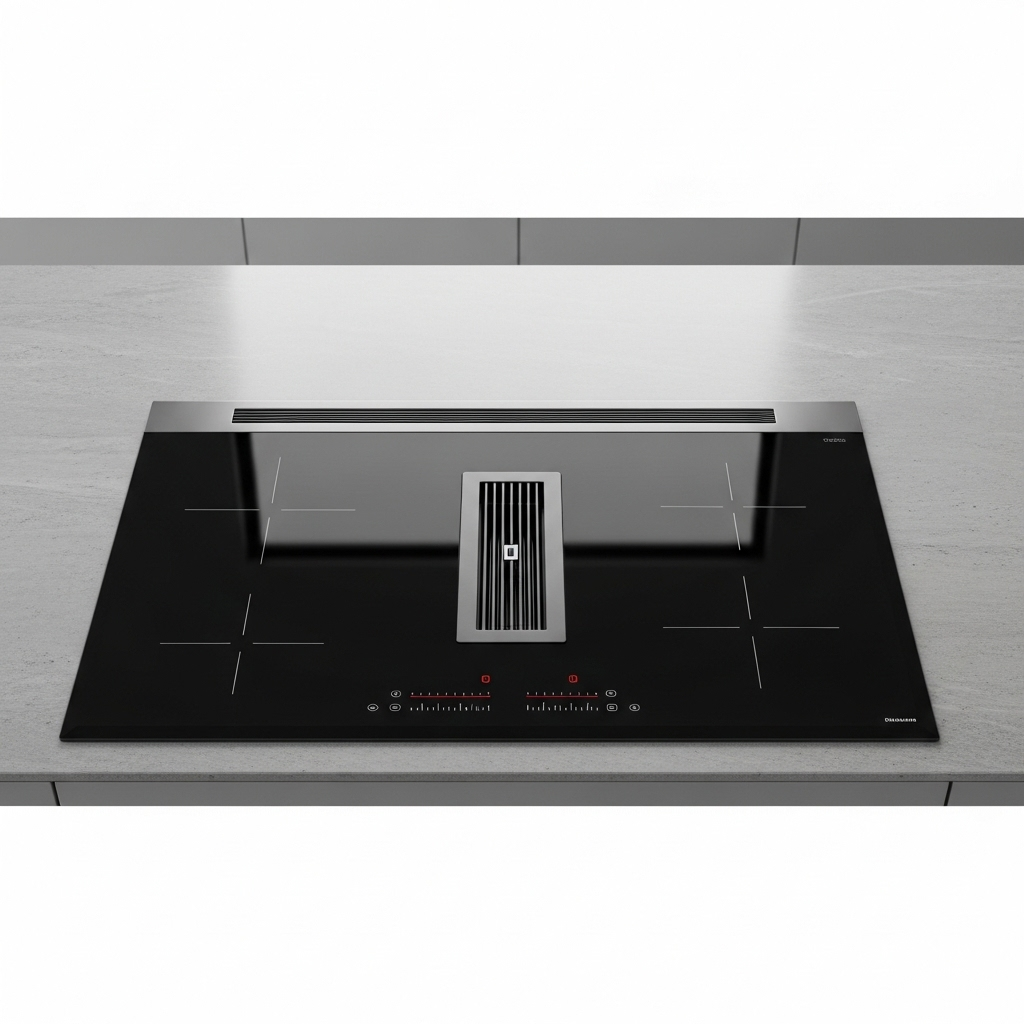
The planning of the extractor fan is a significant design and functional challenge in modern, open kitchens. A technologically sophisticated alternative to the classic extractor hood is the cooktop extractor, often also called a downdraft extractor or downdraft system. In this system, the extractor is integrated directly into the glass-ceramic cooktop. Initially a niche product for design-oriented kitchens, this technology has developed into an important standard in the mid-range and premium price segments. The decision for or against such a system requires a detailed examination of the mode of operation, technical variants, specific advantages and disadvantages, as well as structural requirements. This guide analyzes the technology comprehensively and offers a critical basis for decision-making.

1. Cooktop with integrated extractor: Operating principle and physical basics
The fundamental question many consumers ask is whether extracting cooking fumes downwards can be physically effective, since warm steam (fumes) naturally rises upwards.
- The principle of crossflow: The operating principle is based on generating a targeted crossflow. The fan integrated directly into the cooktop creates an airflow that runs horizontally over the cooking surface. The speed of this flow (often several meters per second) is significantly higher than the natural thermal rising speed of cooking fumes, which is about one meter per second.
- Capture efficiency: Heavy grease and odor particles as well as the steam saturated with water vapor are captured by this stronger crossflow before they have the chance to rise and spread in the room. They are sucked down directly at the edge of pots and pans into the extraction opening. Studies by independent institutes as well as practical experience show that this method can achieve very high efficiency in capturing cooking fumes (the so-called fume capture) when used correctly and with suitable cookware.
- Physical limits: However, a physical limit exists with very tall cookware, such as asparagus or large pasta pots. The steam exiting at the upper edge of such a pot already has a greater distance to the extractor and higher rising energy. It may no longer be fully captured by the crossflow. Some manufacturers therefore recommend placing the lid slightly tilted on tall pots to direct the steam specifically towards the extractor.
2. Advantages and disadvantages: Downdraft extractors compared to classic extractor hoods
A cooktop extractor is usually more expensive to purchase than a separate cooktop and a comparable extractor hood. The decision should be based on a careful weighing of the specific advantages and disadvantages.
Advantages:
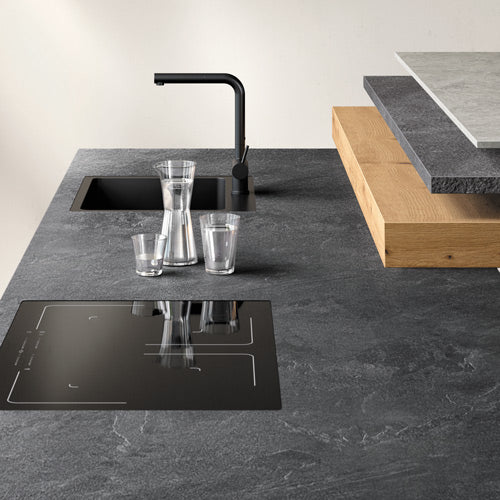
- Planning freedom and aesthetics: This is the most obvious and for many planners the decisive advantage. The elimination of an extractor hood enables unprecedented planning freedom. The cooktop can be placed in locations that were previously problematic: directly in front of a window with a view, under a sloping roof, or in rooms with very high ceilings. The showcase discipline is placement on a minimalist, communicative kitchen island that allows a free line of sight through the entire living space and is no longer dominated by a massive hood.
- Ergonomics and head clearance: The entire area above the cooktop remains free. Bumping the head on a hard stainless steel edge of a classic hood is completely avoided. This not only creates an open and spacious feeling but also makes cooking significantly safer and more comfortable, as one can lean over the pots without restriction.
- Lower noise level at ear height: The motor of the extractor is located in the base of the cabinet and no longer in a hood at head height. Insulated by the furniture itself, its operating noise is often perceived by the user as quieter and more pleasant than with a classic hood, even if the pure decibel values on the energy label may be comparable. High-quality, brushless DC motors additionally contribute to low vibration and quiet operation.
Disadvantages and compromises:
- Loss of storage space: This is a significant and often underestimated disadvantage. The technology of the extractor (motor, filter cassette, air ducts) occupies a considerable part of the storage space in the cabinet below. In modern, compactly built systems, the top drawer can often still be used but must be significantly shortened in depth or the space for an inner drawer is lost. This must be taken into account in the overall kitchen storage planning.
- Higher purchase costs: The combination of a high-quality induction cooktop and a powerful extractor in one device is more expensive to purchase than the sum of the individual components. Installation is usually more complex and thus more costly.
- More complex cleaning: While the surface parts (cover grille, grease filter) are usually easy to remove and dishwasher safe, cleaning the internal components is more complex than wiping a hood. An integrated overflow container safely catches any liquid that gets into the fan during cooking but must be regularly checked and cleaned. The air ducts can also become dirty over time.
- Complex installation: Especially with exhaust air, laying the flat duct systems in the base area of the cabinet, often through several carcasses to the wall outlet, requires very precise planning and execution.
3. Cooktop extractor: Technical aspects and selection criteria
The quality and comfort of a cooktop extractor are reflected in the technical details.
Exhaust air or recirculation:
- Exhaust air: In this variant, the cleaned air is led outside. This requires detailed planning of the exhaust path. Streamlined flat ducts with sufficient cross-section should be used to minimize performance losses.
- Recirculation: Here the air is filtered and returned to the room. The quality of the recirculation system depends decisively on the odor filter used. Regenerable activated carbon filters are more sustainable and cost-effective in the long term than disposable filters that must be replaced every few months. Some manufacturers offer special recirculation filters that also reduce part of the humidity. Nevertheless, complete removal of moisture remains the main advantage of exhaust air systems.
Intelligent automation: High-quality systems often have an air quality sensor that monitors the intensity of cooking fumes (steam, smoke, odor molecules) and automatically adjusts the fan power. This increases comfort as manual control is unnecessary and optimizes energy efficiency since the fan only runs at the power actually needed.
The cooktop itself: Since it is a combined device, the quality features of the induction cooktop must also be evaluated:
- Flexible cooking zones: Allow the use of large cookware such as roasters or grill plates.
- Power levels and operation: Fine power gradation (e.g., 9 or more levels plus booster) and intuitive operation via a touch slider or magnetic knobs are important comfort features.
Designs and arrangement: There are various arrangements of the extractor in the cooktop. Common are central round or elongated extraction openings. Some manufacturers also offer modular systems where narrow cooking modules (dominos) are combined with a separate ventilation module. This can be a space-saving solution for standard cabinet widths. The shape of the extraction opening and the positioning of the cooking zones around it influence the efficiency and usability of the cooktop and should correspond to individual cooking habits.

4. Market overview and important manufacturers of downdraft extractors
The market for cooktop extractors was significantly shaped by the pioneer BORA, which specializes exclusively in this technology. Meanwhile, almost all well-known appliance manufacturers offer their own systems that differ in design, technology, and price. These include, among others, Miele, the BSH Group (Bosch, Siemens, Neff), AEG, and other specialists such as Novy or Elica. A comparison of technical data (airflow in m³/h, noise level in dB(A), grease separation efficiency, energy efficiency class of the fan) and specific construction features is essential before making a purchase decision.
5. Conclusion: Checklist for a well-founded decision
The cooktop extractor is a technologically and aesthetically sophisticated solution that, however, requires compromises. The decision for or against such a system should be based on a rational weighing of personal priorities. The following questions can help in planning:
- Priorities: How important is a minimalist look and maximum head clearance compared to loss of storage space and higher costs? Is the free view in my specific room situation worth the extra cost?
- Cooking habits: Do I often cook with very tall pots, which could limit the system's effectiveness? How important is the use of large roasters that require flexible cooking zones?
- Budget: Does the significant surcharge for a cooktop extractor and the more complex installation fit into my overall kitchen budget?
- Structural conditions: Is a complex exhaust air routing in the base area feasible, or is a high-quality recirculation system the better choice? Do I have enough space in the base cabinet, or is every centimeter of storage space crucial?
For plans where an open, communicative aesthetic and free sightlines are paramount, the integrated cooktop extractor is a very good and often the best solution. In all other cases, especially in closed kitchens, a modern, quiet head clearance hood often represents the functionally and economically more balanced alternative, which does not consume storage space in the base cabinet and offers very good capture efficiency with tall pots.
View full article
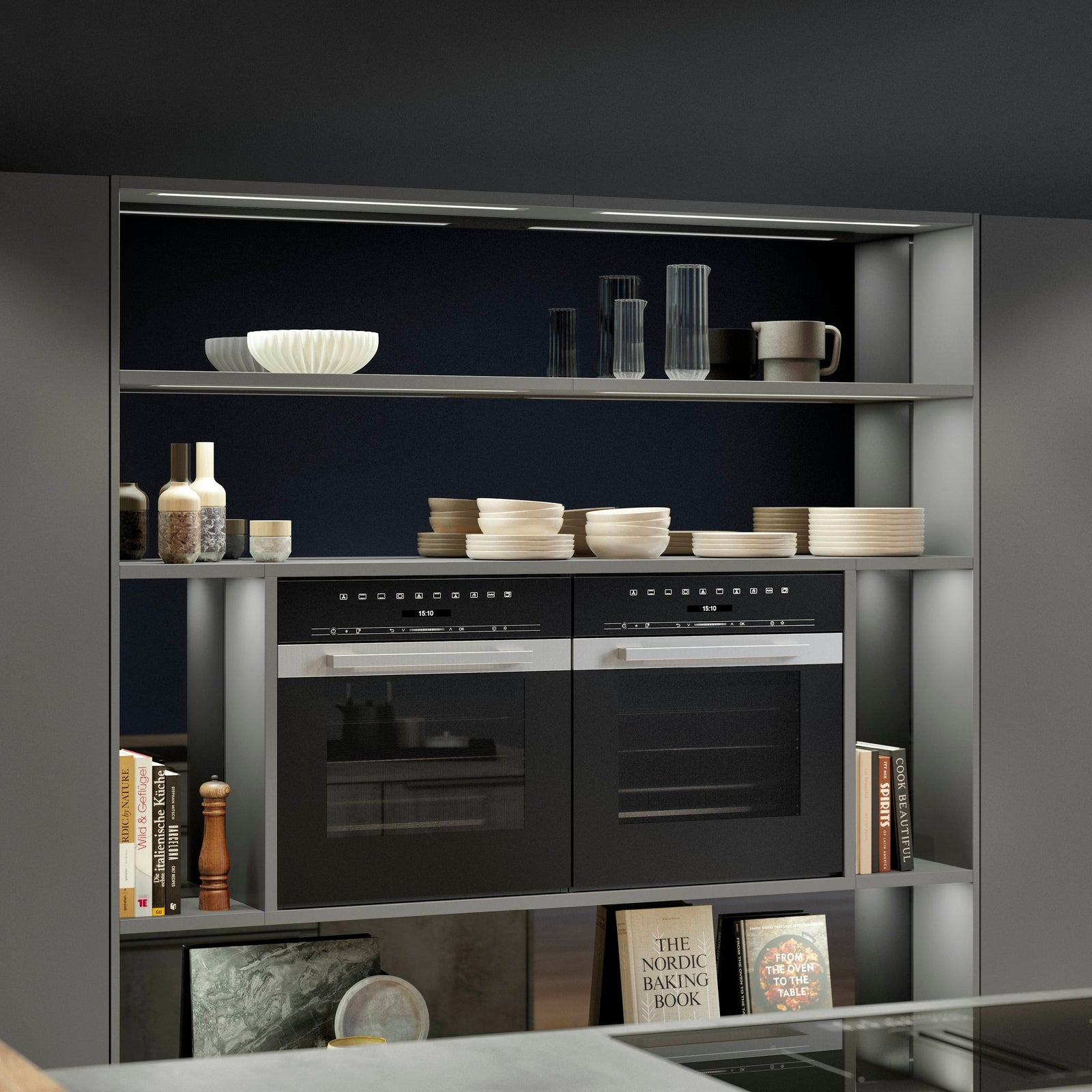

Gerätetechnische Erweiterungen im Nobilia-Portfolio 2026
Moderne Küchen verlangen einfache Wartung und vielseitige Küchengeräte. Nobilia präsentiert 2026 mit dem BORA GPNext und exklusiven Electrolux-Neuheiten technische Erweiterungen für das mittlere Segment. Diese Innovationen beschleunigen den Filterwechsel und bieten Planern eine zentrale Lösung, ein Highlight unter den Küchentrends 2026.
View full article

Effektive Raumnutzung und Beleuchtungskonzepte in der modernen Küche
Viele Küchen leiden unter ungenutztem Stauraum und fehlender Beleuchtung in der Küche. Praxisorientierte Konzepte ermöglichen optimale Raumnutzung und funktionale, stimmungsvolle Küchenbeleuchtung. Tipps reichen von deckenhohen Schränken bis zu smarten Lichtkonzepten für perfektes Licht und maximale Funktion.
View full article

Farbtrends in der Küche: So schaffen Sie Ruhe und Natürlichkeit
Sterile Küchen wirken unpersönlich und kalt. Sanfte Erdtöne als Wandfarbe in der Küche schaffen eine warme, natürliche Atmosphäre. Küchentrends 2025 zeigen, wie Sie Ruhe und Geborgenheit erreichen.
View full article

Natursteinoberflächen reinigen und pflegen
Wussten Sie, dass unsachgemäße Pflege die Lebensdauer Ihrer Küchenarbeitsplatte aus Naturstein um bis zu 50 % verkürzen kann? Mit jahrelanger Erfahrung in Küchenmöbeln und Natursteinflächen liefere ich klare Tipps zur Reinigung, Imprägnierung und Fleckenschutz. So bleibt Ihre Arbeitsplatte makellos und langlebig.
View full article

Polymerglas in Küche und Wohnraum
Falsche Reinigung kann Polymerglas in Ihrer Küche dauerhaft schädigen. Optimierte Pflegehinweise für Smartglas verhindern Trübungen und Spannungsrisse. Praxisnahe Tipps sorgen für schonende Reinigung und langfristige Werterhaltung Ihrer Küchenfronten.
View full article

Reinigung und Pflege von Kühlschrank und Geschirrspüler
Kühlschrank und Geschirrspüler leiden unter verstopften Kondenswasserabläufen und verschmutzten Dichtungen. Als Profi für Küchengerätewartung zeige ich praxisnahe Tipps für kühlschrank richtig reinigen, Geschirrspülerpflege und effektive Filterkontrolle. So vermeiden Sie Schimmel, senken den Energieverbrauch und verlängern die Lebensdauer Ihrer Geräte.
View full article Gerätetechnische Erweiterungen im Nobilia-Portfolio 2026
Moderne Küchen verlangen einfache Wartung und vielseitige Küchengeräte. Nobilia präsentiert 2026 mit dem BORA GPNext und exklusiven Electrolux-Neuheiten technische Erweiterungen für das mittlere Segment. Diese Innovationen beschleunigen den Filterwechsel und bieten Planern eine zentrale Lösung, ein Highlight unter den Küchentrends 2026.
View full article Effektive Raumnutzung und Beleuchtungskonzepte in der modernen Küche
Viele Küchen leiden unter ungenutztem Stauraum und fehlender Beleuchtung in der Küche. Praxisorientierte Konzepte ermöglichen optimale Raumnutzung und funktionale, stimmungsvolle Küchenbeleuchtung. Tipps reichen von deckenhohen Schränken bis zu smarten Lichtkonzepten für perfektes Licht und maximale Funktion.
View full article Farbtrends in der Küche: So schaffen Sie Ruhe und Natürlichkeit
Sterile Küchen wirken unpersönlich und kalt. Sanfte Erdtöne als Wandfarbe in der Küche schaffen eine warme, natürliche Atmosphäre. Küchentrends 2025 zeigen, wie Sie Ruhe und Geborgenheit erreichen.
View full article